Product Introduction
At present, the conventional QJ44-type DC bridge is widely used for contact resistance measurement in electric power systems. However, the test current of such bridges is only at the milliampere level, making it difficult to detect defects such as reduced cross-sectional area of circuit conductors. When measuring the contact resistance of high-voltage switch circuits, the presence of oil films and oxide layers often results in significantly higher measured values that fail to reflect the true contact resistance.
To address this issue, both the standard SD301-88 AC 500kV Power Equipment Handover and Preventive Test Regulations and the new version of the Preventive Test Regulations for Power Equipment stipulate that the measurement current for circuit breaker and isolating switch contact resistance shall be no less than 100 A DC to ensure the accuracy of test results.
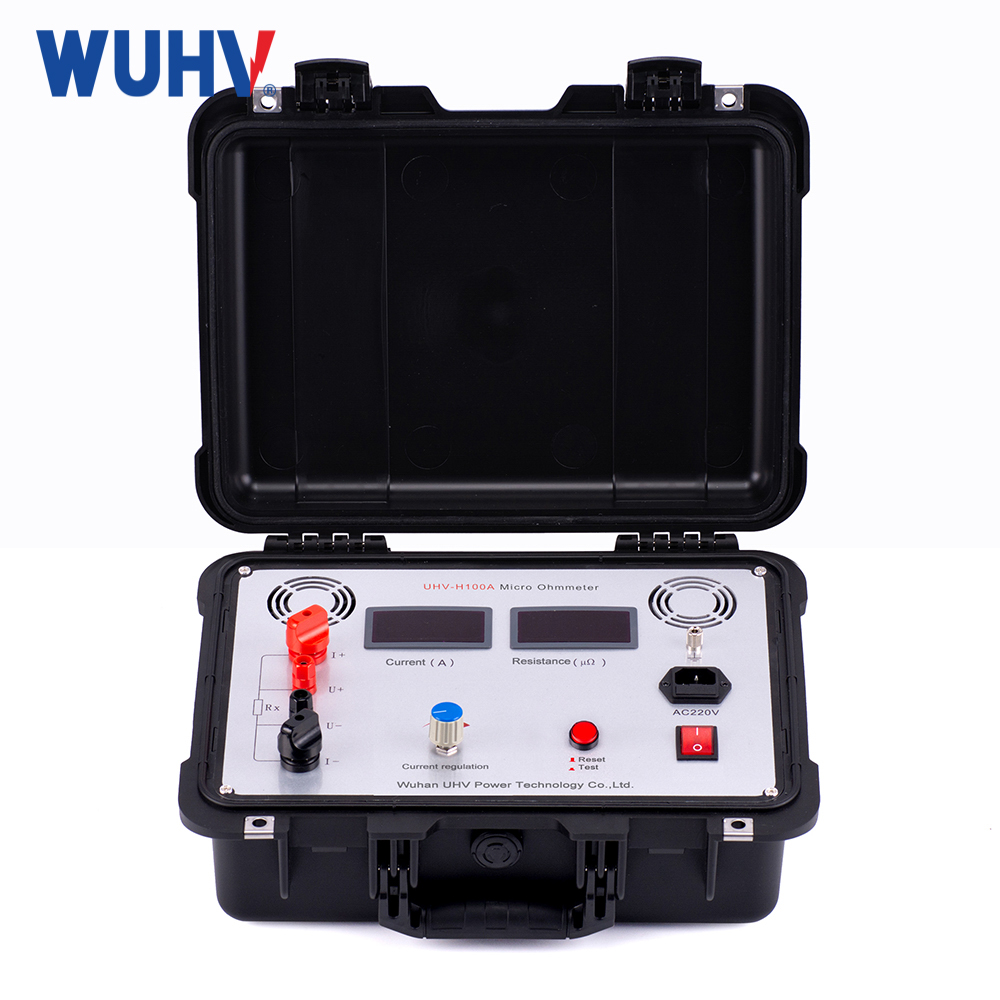
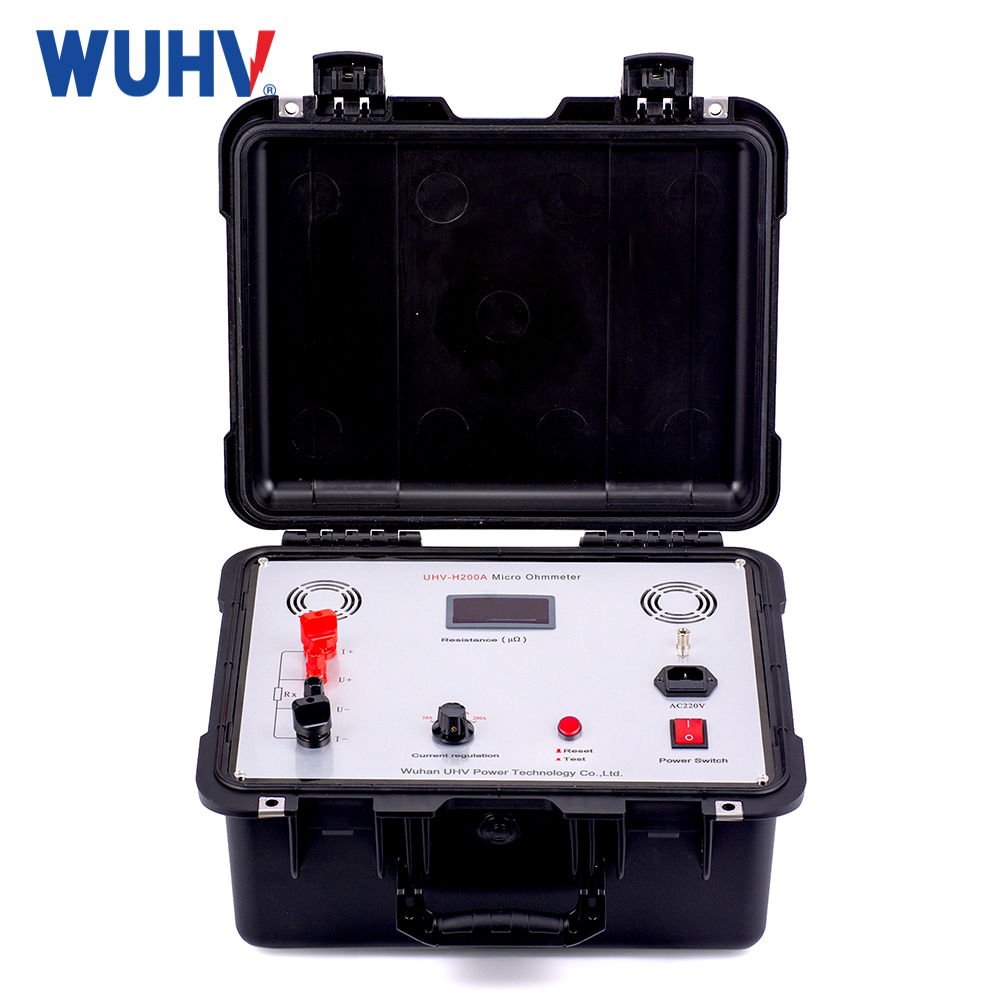
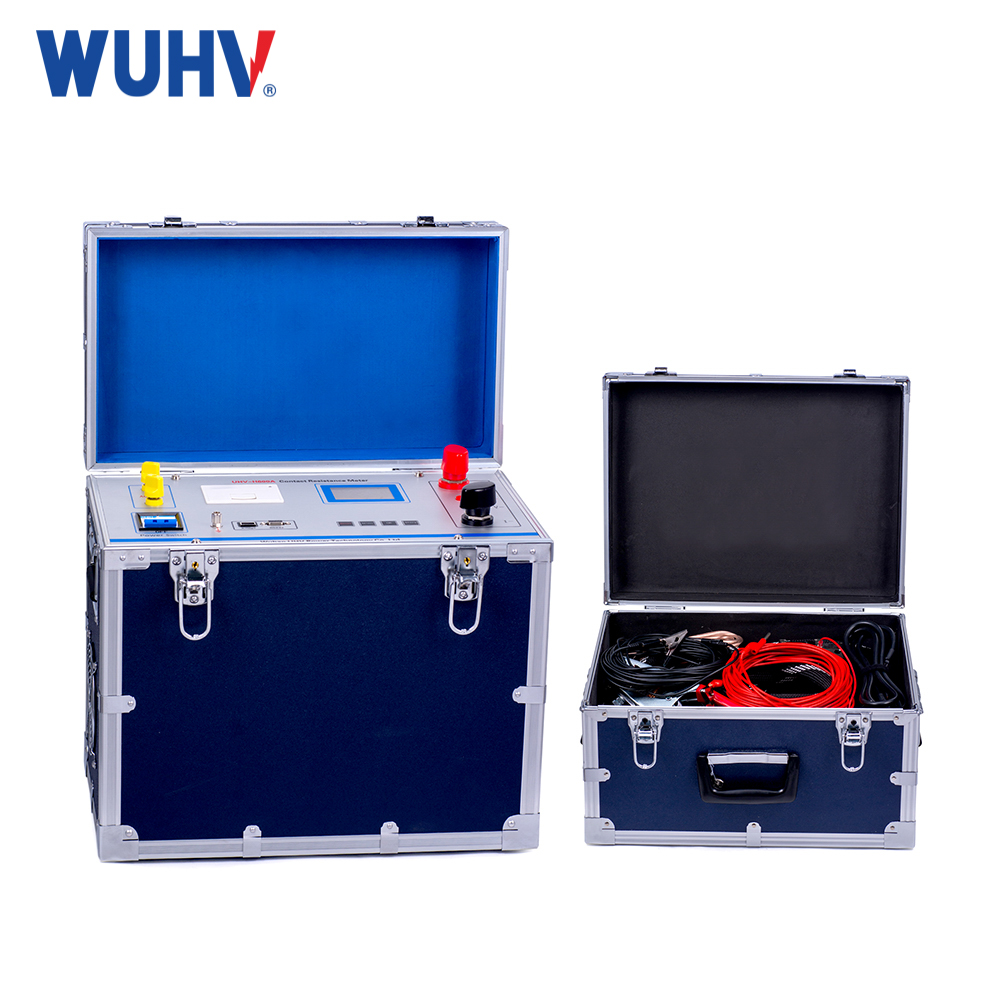
The Switch Micro-Ohmmeter produced by Wuhan UHV is designed in accordance with the implementation standard DL/T 845.4-2004 of the new Electric Power regulations of the People's Republic of China, combining high-frequency switching power supply technology with digital circuit technology. This micro-ohmmeter is suitable for resistance measurement in switch control equipment circuits. contact resistance tester supplier offers high measurement accuracy and stable performance, fully meeting the requirements of high-voltage switch maintenance and factory circuit resistance testing for high-voltage switches.
 |  |
What is a contact resistance tester?
The contact resistance tester, also commonly referred to as a loop resistance tester, is a specialized instrument designed for the precise measurement of micro-ohm (μΩ) level resistance. It is primarily used to verify whether the contact resistance of various electrical connection points in power systems—such as switchgear, busbars, and cable joints—meets the required standards.
Its development was mainly driven by the inadequacy of traditional measurement methods (such as the double-arm bridge) when measuring such extremely low resistance values.
Các thông số kỹ thuật
| easuring range | 1~1999μΩ |
| Nghị quyết | 1mΩ |
| Kiểm tra hiện tại | DC 100A fixed output |
| Sự chính xác | 0,5% ± 1 ngày |
| Operating mode | Tiếp diễn |
| Chế độ hiển thị | 3.5-digit LED display |
| Nguồn cấp | AC220V±10% 50Hz |
| Môi trường làm việc | Temperature: -10℃~40℃, humidity: ≤80%RH |
| kích thước | 390×300×150mm3 |
| Cân nặng | 6kg(excluding attachments) |
Product Characteristics
1. High-Current Output: The Switch Micro-Ohmmeter adopts advanced power supply technology, enabling continuous output of large current over extended periods. It effectively penetrates the oxide film on switch contacts, ensuring reliable test results.
2. Strong Anti-Interference Capability: Even under severe interference conditions, the last digit of the LCD reading remains stable within ±1 count. The contact resistance tester factory provides stable readings and good repeatability.
3. Long Service Life: High-precision resistors are used throughout, effectively eliminating the influence of ambient temperature on measurement results. Additionally, military-grade connectors enhance vibration resistance.
4. Easy to Carry: Compact size and light weight for convenient portability.
Application Scenarios of the Contact Resistance Tester
Power systems: Preventive testing and maintenance of substations, transmission and distribution equipment, and high-voltage switchgear.
Equipment manufacturing: Factory testing and quality control of products such as switchgear, circuit breakers, and busbars.
Industrial and new energy sectors: Reliability verification of high-current connection points in photovoltaic, energy storage, electric vehicles, and rail transit applications.
Operation, maintenance, and R&D: Equipment condition monitoring, fault diagnosis, and performance testing of new materials and new connection solutions.
FAQs
Q:Why is a high test current important for contact resistance measurement?
A:Low-current measurement may be affected by oxide films and surface contamination on electrical contacts. The 100A DC test current helps overcome these effects and provides a more representative measurement of the actual contact resistance.
Q:What causes high contact resistance in a circuit breaker?
A:Common causes include contact burning caused by short-circuit currents, oxidation of contact surfaces, insufficient contact pressure, mechanical wear, spring deformation, poor adjustment, and contamination of the contact surfaces.
Q:What is the difference between a contact resistance tester and a conventional resistance meter?
A:A contact resistance tester is specifically designed to measure very low resistance values at the micro-ohm level. Its high test current makes it particularly suitable for evaluating high-current electrical contacts where conventional low-current resistance measurement may not provide representative results.
matters needing attention
1. Please read the instruction manual carefully before using the loop resistance tester.
2. Please follow the correct wiring method in the instruction manual to connect the wires.
3. This mirco-ohm meter is not allowed to test the circuit resistance in live circuits.
4. The contact resistance tester manufactures must be reliably grounded during use.
5. Current line users are not allowed to replace them at will.
6. When not in use, the contact resistance tester manufactures should be stored in a ventilated, dry, cool, and clean place, paying attention to moisture and corrosive gases.
Basic knowledge of contact resistance
1. What is contact resistance tester?
Contact resistance tester is the additional resistance that occurs when a stationary contact comes into contact with a moving contact.
2. What are the components of the contact resistance of a circuit breaker?
It consists of two parts: the contraction resistance and surface resistance of the contact parts of the moving and stationary contacts.
3. What are the reasons for the unqualified contact resistance of the circuit breaker?
1) When breaking a large short-circuit current, the contact burns out.
2) Due to poor institutional adjustment and unstable fixation, the stroke changes. When the overtravel is severely unqualified, it can cause changes in contact pressure or contact area.
3) After the debugging and installation of the circuit breaker, if it is not put into operation for a long time, the surfaces of the moving and stationary contacts will oxidize and the contact surface resistance will increase.
4) Long term operation causes the spring to deform, resulting in a decrease in contact pressure.
5) Mechanical wear caused by long-term operation of mechanical parts.
6) For low oil circuit breakers, it is also possible for the insulation oleic acid value to be unqualified and cause acidic reactions, which can corrode the contact surface. Or floating impurities in the oil, caused by the interruption of short-circuit current between the moving and stationary contacts. The residual carbonaceous particles and metal powders increase the contact resistance.
4. What are the factors that affect contact resistance?
1) - Material properties: resistivity, hardness, chemical properties, mechanical strength and resistivity of metal compounds.
2) Contact forms: point contact, line contact, surface contact.
3) Contact surface condition: When an oxide film is formed on the contact surface (except for silver), the resistance of the oxide film is much higher than that of the metal itself.
4) Contact pressure.
5) Surface roughness of contact.
UHV specializes in the R&D and manufacturing of high-quality electrical testing equipment, capable of accurately measuring the contact resistance of circuit breakers, switchgear, disconnecting switches, and other high-voltage electrical equipment. As an experienced manufacturer and supplier, we offer:
Reliable product quality
Competitive prices
Professional technical support
Flexible customized solutions
Welcome to contact CNUHV for the latest product specifications, availability, and factory-direct prices.